Beta Glucanase Enzyme Brewing: Dosage, pH, and Temperature Guidance
Beta glucanase for brewing at wholesale: dosage, mash pH and temperature, QC and supplier checks for breweries, maltsters and distributors. Bulk supply, quoted per order.
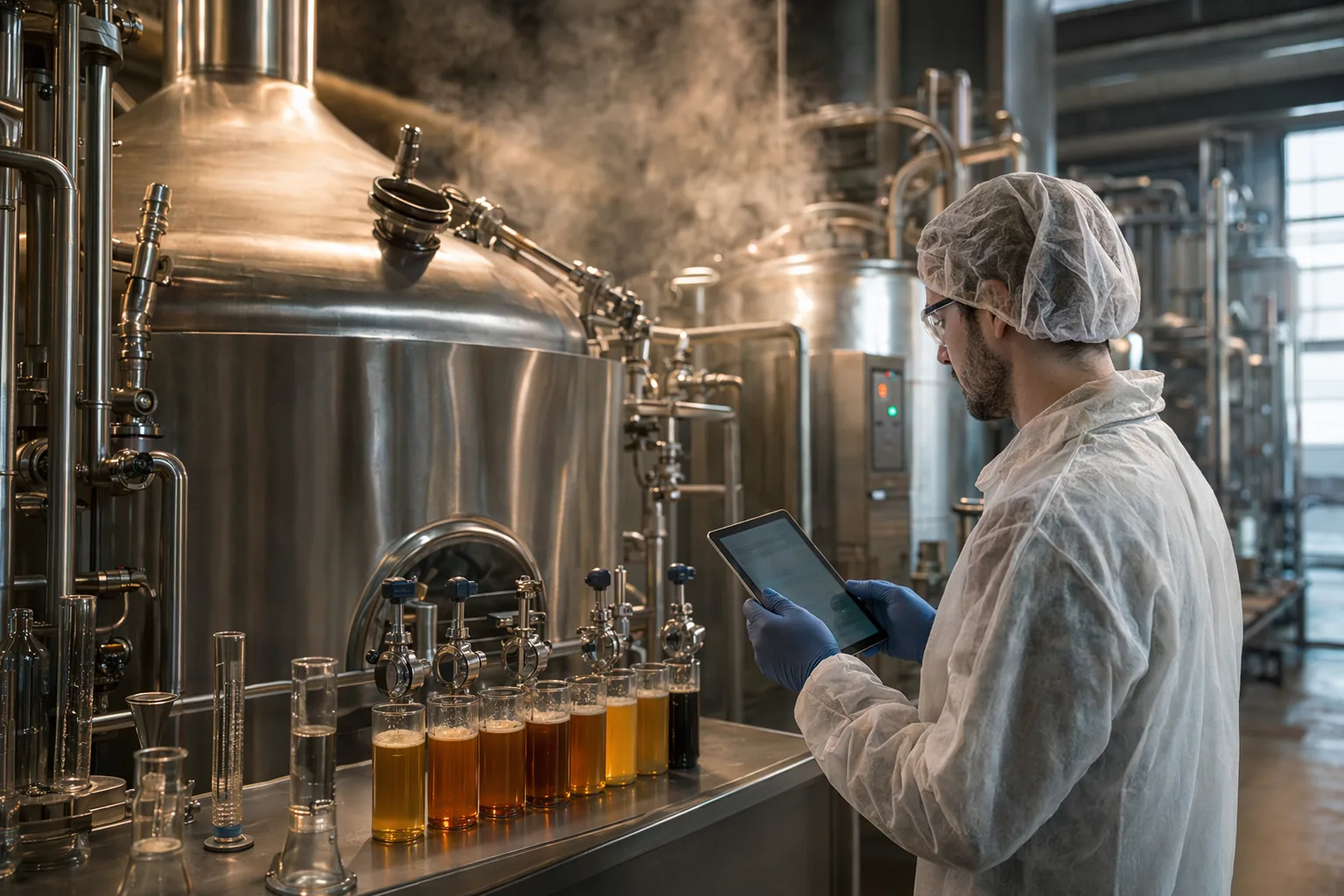
For breweries, maltsters and the distributors who supply them, facing slow lautering, high wort viscosity or filter blinding: beta glucanase controls beta-glucans when it is selected, dosed and validated against real grist and process conditions. This guide covers dosage, mash conditions, QC and supplier qualification; to buy in bulk, send the grade, quantity and destination country for a quote.
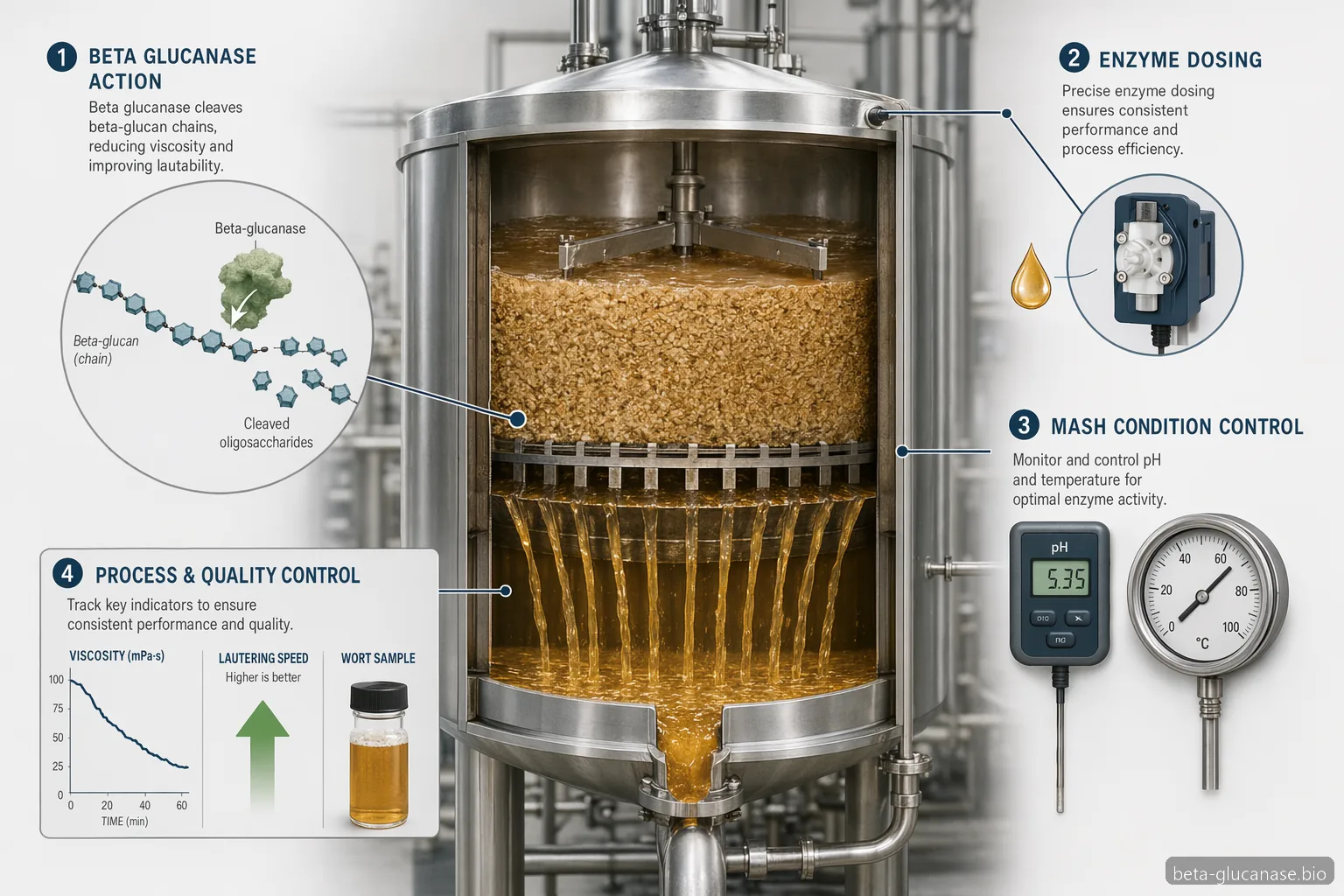
Troubleshooting Beta-Glucans in the Brewhouse
Beta glucans are mixed-linkage polysaccharides found in cereal cell walls. In brewing, they are most relevant when malt modification is variable, high-adjunct recipes are used, or foods with high beta glucans such as barley, oats, rye, and wheat are part of the grist. Excess beta-glucans can increase wort viscosity, slow lautering, reduce extract recovery, blind filters, and create inconsistent tank-to-tank performance. A beta glucanase enzyme brewing program targets these process problems, not consumer supplement claims. The enzyme hydrolyzes beta-glucans into lower-molecular-weight fragments that are easier to separate during lautering and filtration. For troubleshooting, start with a clear baseline: grist bill, mash profile, runoff time, turbidity, wort viscosity, extract, filtration delta pressure, and finished beer stability observations. This data helps determine whether beta glucanase, process adjustment, malt specification changes, or a combined approach is most economical.
Common symptoms: slow runoff, compact mash bed, high viscosity, filter pressure rise. • High-risk inputs: under-modified malt, barley adjunct, oats, rye, wheat, and mixed cereal recipes. • Primary goal: improve process consistency while protecting beer quality targets.
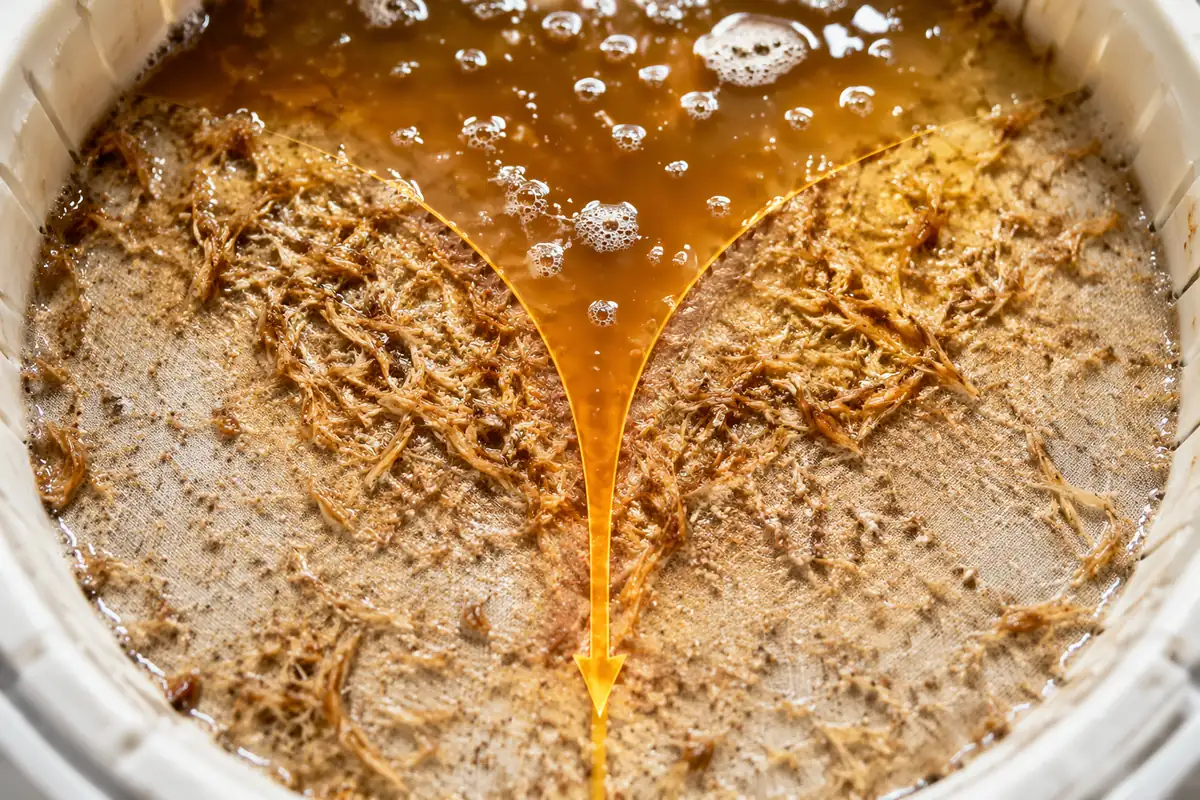
Dosage Strategy for Industrial Beta Glucanase Enzyme Brewing
Commercial beta glucanase products vary by source organism, endo-glucanase activity, concentration, stabilizers, and carrier system, so dosage should never be copied without checking the TDS. For first-pass pilot work, many breweries screen 50-300 g of commercial product per metric ton of grist, then convert results to declared activity units for scale-up. Start near the low end when malt beta-glucans are moderate and process time is adequate; move higher when adjunct load is high, lautering is constrained, or wort viscosity remains above target. Dose into mash-in water or early mash for rapid dispersion, avoiding undiluted contact with hot surfaces. Record enzyme lot, addition point, mash pH, temperature, hold time, and analytical results. The best industrial beta glucanase enzyme brewing dosage is the minimum dose that delivers the required runoff, filtration, and quality improvement at the lowest cost-in-use.
Pilot screen: 50-300 g product per metric ton of grist, adjusted to activity units. • Addition point: mash-in water or early mash, with strong mixing. • Decision rule: select the lowest effective dose, not the highest apparent performance.
pH, Temperature, and Hold Time in Brewing Mash Conditions
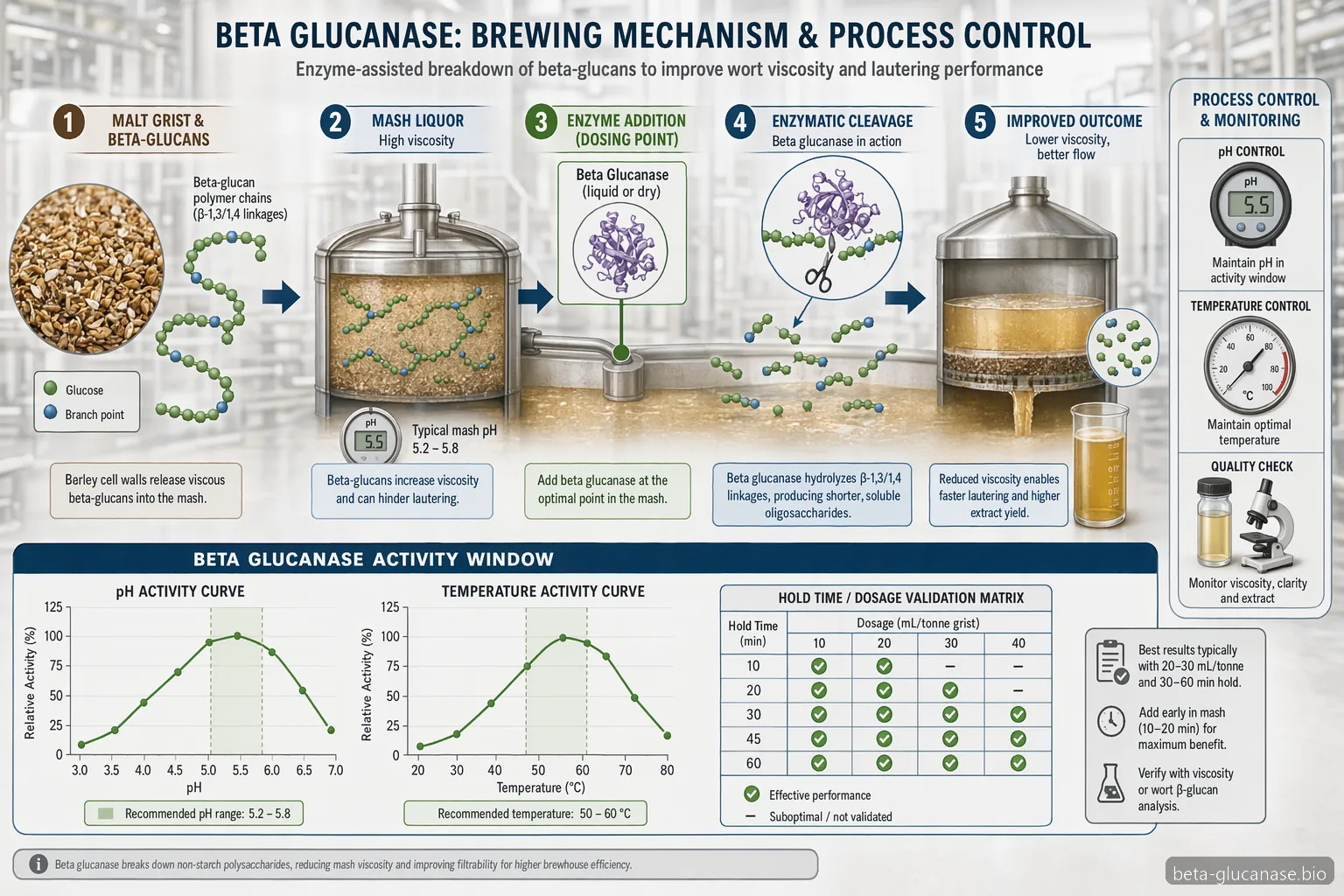
Beta glucanase enzyme for brewing must match the real mash window, not only a laboratory optimum. Many brewing-relevant products are evaluated around pH 4.5-6.0 and 45-65 degrees C, but the exact operating window depends on the enzyme source and formulation. Check the TDS for optimum pH, temperature stability, and deactivation guidance. In practice, activity is often strongest during lower-temperature mash rests before hotter saccharification or mash-out steps. A 15-45 minute contact time may be enough for many trials, but high beta-glucan loads or coarse grist may need longer exposure. Excessive heat, incorrect pH, or late addition can reduce performance and create misleading trial results. When troubleshooting, compare a control mash against treated mashes at identical pH, temperature, liquor-to-grist ratio, and mixing intensity to isolate the enzyme effect.
Typical evaluation pH: 4.5-6.0, subject to supplier TDS. • Typical evaluation temperature: 45-65 degrees C, subject to enzyme stability. • Typical contact time: 15-45 minutes before high-temperature steps.
QC Checks, Pilot Validation, and Cost-in-Use
A strong beta glucanase brewing trial uses measurable QC endpoints rather than visual impressions alone. Pre-trial data should include malt COA values where available, grist composition, mash pH, runoff time, first wort clarity, extract, viscosity, and filterability. During pilot validation, compare untreated control, low dose, mid dose, and high dose under the same process conditions. Useful checks include wort viscosity, beta-glucan concentration where testing is available, lauter time, spent grain moisture, turbidity, filtration delta pressure, extract yield, and sensory review. Cost-in-use should include enzyme price, dosage, yield impact, reduced filtration aids if applicable, labor savings, throughput improvement, and waste handling effects. A supplier may offer a strong unit price, but the better choice is the product that reaches the operating target with reliable lot-to-lot activity, easy handling, and documented technical support.
Run a control and at least two treated dosage levels. • Track viscosity, runoff time, filter delta pressure, extract, and turbidity. • Calculate cost-in-use per hL or per metric ton of grist.
How to Qualify a Beta Glucanase Enzyme Supplier for Brewing
A beta glucanase enzyme supplier for brewing should support procurement, QA, and production teams with complete documentation and realistic technical guidance. Request a current COA for the offered lot, a TDS with activity definition and process conditions, and an SDS covering safe handling, storage, and transport. Ask for enzyme activity method, recommended storage temperature, shelf life, carrier and preservative disclosure, allergen statement where relevant, and compatibility with your cleaning and dosing equipment. Avoid relying on generic claims such as broad-spectrum performance without data for your mash profile. Supplier qualification should also cover sample availability, batch traceability, lead time, packaging options, minimum order quantity, technical response time, and change notification practices. For B2B buyers, the right beta glucanase partner is one that helps validate performance before full-scale purchasing.
Required documents: COA, TDS, SDS, activity method, storage guidance. • Commercial checks: lead time, MOQ, packaging, traceability, sample support. • Technical checks: dosage conversion, pilot protocol, and troubleshooting support.
Compare the Operating Window Before Comparing Price
A beta glucanase brewing specification should state the recommended pH range, temperature range, dosage band, and application point. Typical mash use is often evaluated around pH 5.0–5.8 and 45–65 °C, but the usable range depends on the enzyme source and formulation. Some products are designed for lower-temperature beta-glucan rests, while others tolerate warmer mash steps. Dosage may be expressed as grams per metric ton of malt, milliliters per metric ton of grist, or activity units per kilogram of substrate; because activity assays vary, compare performance at equal brewery conditions rather than assuming unit equivalence. Boiling usually inactivates the enzyme, but verify residual activity expectations in the TDS for your process and product style.
Confirm whether the product is optimized for mash-in, beta-glucan rest, or adjunct slurry treatment. • Ask whether calcium, sulfite, or cleaning chemical residues affect activity. • Record actual mash pH, temperature ramp, hold time, and grist composition during trials.
Wholesale Supply: What to Send for a Brewing Quote
Brewing beta-glucanase is supplied for breweries, maltsters, brewing-ingredient distributors and resellers, and every order is quoted individually. To get a quote that matches your brewhouse, send three things: the product or activity grade you use today (or your grist bill and adjunct share if you are starting out), the quantity per order or per month, and the destination country. Standard supply is a light-brown powder at 10,000–50,000 U/g with higher grades on request, packed in 25 kg fiber drums or custom packaging, with a 25 kg minimum order and a 12-month shelf life sealed in a cool, dry place. A free 100 g evaluation sample with COA and TDS is sent with qualified inquiries, so you can run the pilot described above before a bulk order.
Send: grade or application, quantity, destination country. • Supply: 25 kg fiber drums or custom packaging, 25 kg minimum order, pricing quoted per order. • Evaluation: free 100 g sample with COA and TDS, reply within 24 hours.
Technical Buying Checklist
Buyer Questions
Beta glucans are cereal cell-wall polysaccharides found in barley, oats, rye, wheat, and related grains. In brewing, excessive or high-molecular-weight beta-glucans can raise wort viscosity and reduce lautering or filtration performance. The issue is process-related: it affects separation, throughput, and consistency. A beta glucanase enzyme breaks beta-glucans into smaller fragments that are easier to manage during normal brewhouse operations.
Consider beta glucanase when you see slow lauter runoff, high wort viscosity, filter blinding, poor extract recovery, or variability linked to malt quality or adjunct use. It is especially relevant for recipes using foods with high beta glucans, including barley adjunct, oats, rye, and wheat. Before routine use, run a controlled pilot to confirm the enzyme improves your actual process economics.
A practical pilot screening range is often 50-300 g of commercial enzyme product per metric ton of grist, but the correct dose depends on activity units, enzyme formulation, mash conditions, and beta-glucan load. Always check the supplier TDS and convert dosage to declared activity. Select the lowest dose that meets runoff, viscosity, filtration, and quality targets with acceptable cost-in-use.
Many industrial beta glucanase enzyme brewing trials evaluate performance around pH 4.5-6.0 and 45-65 degrees C. However, each formulation has its own optimum and stability profile, so the supplier TDS is the controlling reference. In many mash programs, addition during mash-in or an early lower-temperature rest gives the enzyme enough time before hotter steps reduce activity.
Compare suppliers using documentation, pilot data, and cost-in-use. Request COA, TDS, SDS, activity method, lot traceability, storage guidance, shelf life, carrier disclosure, and sample support. In trials, measure viscosity, runoff time, filtration delta pressure, extract, and sensory impact. The best beta glucanase enzyme supplier for brewing is the one that delivers consistent technical performance and practical QA support.
Beta-Glucanase for Research & Industry
Need Beta-Glucanase for your lab or production process?
ISO 9001 certified · Food-grade & research-grade · Ships to 80+ countries
Frequently Asked Questions
What are beta glucans in brewing raw materials?
Beta glucans are cereal cell-wall polysaccharides found in barley, oats, rye, wheat, and related grains. In brewing, excessive or high-molecular-weight beta-glucans can raise wort viscosity and reduce lautering or filtration performance. The issue is process-related: it affects separation, throughput, and consistency. A beta glucanase enzyme breaks beta-glucans into smaller fragments that are easier to manage during normal brewhouse operations.
When should a brewery use beta glucanase enzyme for brewing?
Consider beta glucanase when you see slow lauter runoff, high wort viscosity, filter blinding, poor extract recovery, or variability linked to malt quality or adjunct use. It is especially relevant for recipes using foods with high beta glucans, including barley adjunct, oats, rye, and wheat. Before routine use, run a controlled pilot to confirm the enzyme improves your actual process economics.
What dosage of beta glucanase should be used in brewing?
A practical pilot screening range is often 50-300 g of commercial enzyme product per metric ton of grist, but the correct dose depends on activity units, enzyme formulation, mash conditions, and beta-glucan load. Always check the supplier TDS and convert dosage to declared activity. Select the lowest dose that meets runoff, viscosity, filtration, and quality targets with acceptable cost-in-use.
What pH and temperature are best for beta glucanase in mash?
Many industrial beta glucanase enzyme brewing trials evaluate performance around pH 4.5-6.0 and 45-65 degrees C. However, each formulation has its own optimum and stability profile, so the supplier TDS is the controlling reference. In many mash programs, addition during mash-in or an early lower-temperature rest gives the enzyme enough time before hotter steps reduce activity.
How do I compare beta glucanase enzyme suppliers for brewing?
Compare suppliers using documentation, pilot data, and cost-in-use. Request COA, TDS, SDS, activity method, lot traceability, storage guidance, shelf life, carrier disclosure, and sample support. In trials, measure viscosity, runoff time, filtration delta pressure, extract, and sensory impact. The best beta glucanase enzyme supplier for brewing is the one that delivers consistent technical performance and practical QA support.
When should beta glucanase be added in the mash?
The best addition point depends on the enzyme and mash program. Many breweries evaluate addition at mash-in or during a beta-glucan rest, often within pH 5.0–5.8 and a moderate temperature window such as 45–65 °C. The supplier’s TDS should define the recommended operating range. Confirm performance with pilot brews before changing production recipes.
Can beta glucanase be used with high-adjunct brewing recipes?
Yes, beta glucanase is often considered when recipes include barley adjuncts, oats, rye, wheat fractions, or other materials associated with higher beta glucans. However, the enzyme should be tested against the exact grist, mash ratio, pH, temperature, and hold time used in production. High-adjunct systems may need dose optimization and additional QC checks for extract, viscosity, lautering, filtration, and finished beer quality.
What QC tests show whether beta-glucanase is working?
Useful checks include mash or wort viscosity, lauter time, runoff clarity, extract yield, turbidity, filtration throughput, and residual beta-glucans where the brewery has access to testing. A calcofluor-based beta-glucan method or filtration index can add quantitative evidence. Always include a no-enzyme control so improvements are not confused with malt lot or process variation.
Request a Bulk Brewing Beta-Glucanase Quote
Send the activity grade or your grist and adjunct share, the quantity per order or per month, and the destination country. We reply within 24 hours with a grade recommendation, a free evaluation sample with COA/TDS and a bulk quote. Specs for the lautering application: /applications/beta-glucanase-brewing-wort-viscosity/
Contact Us to Contributehello@mail.beta-glucanase.bio