Beta Glucanase Enzyme for Brewing Process Control
B2B guide to beta glucanase enzyme for brewing: use points, pH, temperature, dosage, QC checks, COA/TDS/SDS review, and pilot validation.
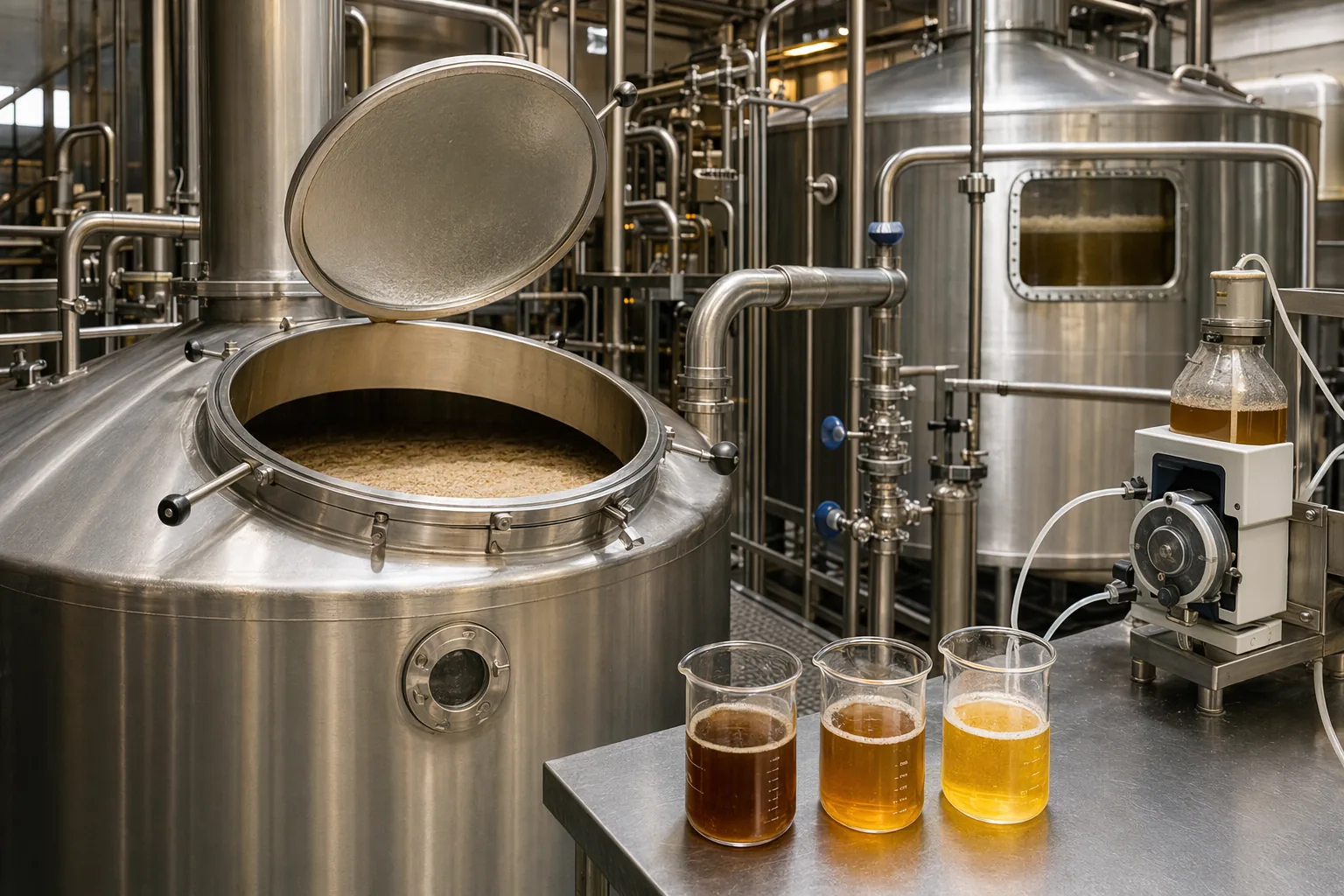
A practical guide for brewers and procurement teams evaluating beta glucanase enzyme to manage wort viscosity, filtration performance, and process consistency.
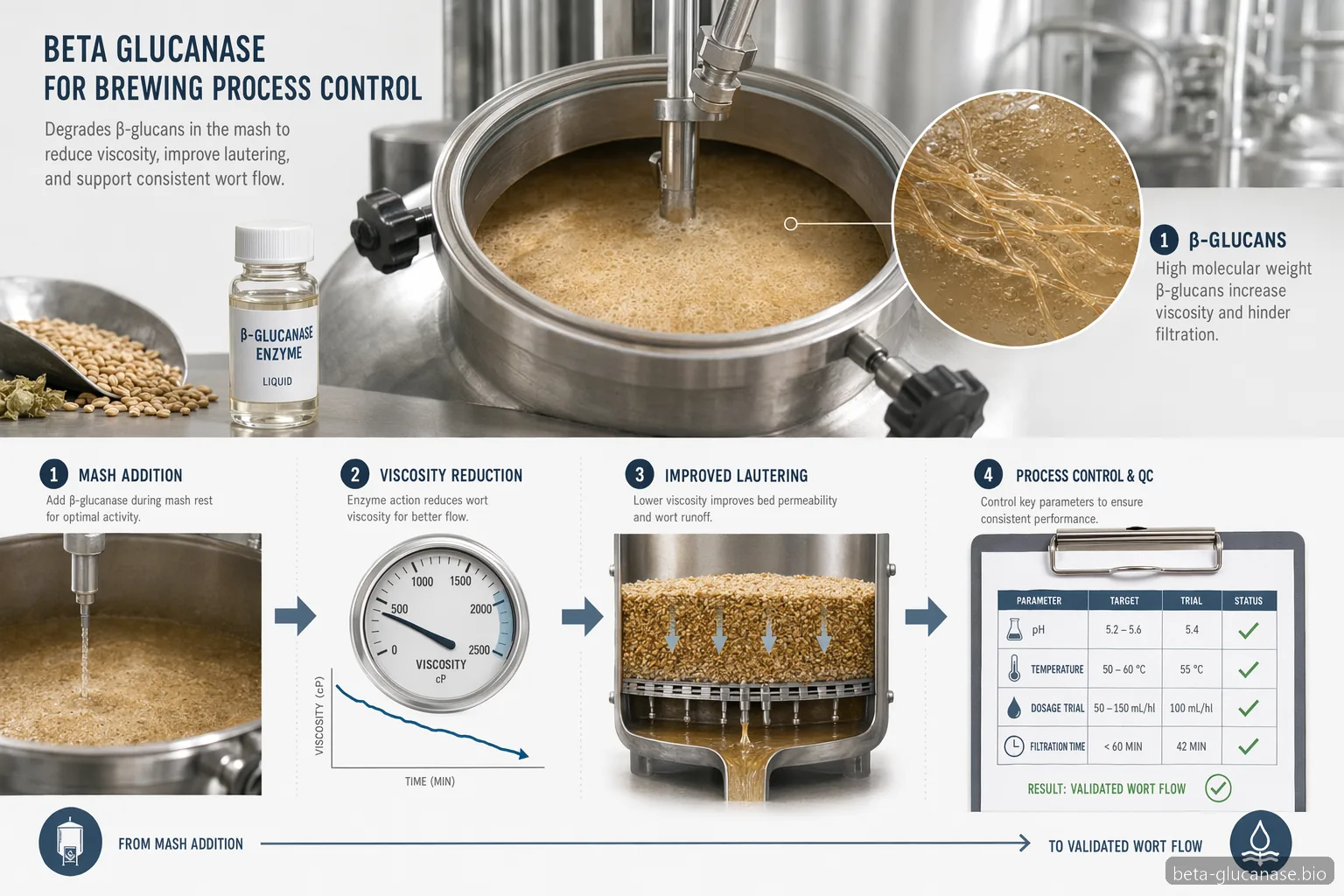
What Is Beta Glucanase in Brewing?
Beta glucanase, also written beta-glucanase, is an industrial enzyme preparation used to break down beta glucans in brewing raw materials. For buyers asking what is beta glucanase, the practical answer is that it targets long-chain beta-glucans that can increase mash and wort viscosity. These polysaccharides are naturally present in barley cell walls and may be higher in under-modified malt, unmalted barley, oats, rye, and some adjunct streams. While foods with high beta glucans are often discussed in nutrition, this page focuses only on industrial brewing performance, not dietary or medical use. In a brewery, a beta glucanase enzyme can support faster wort separation, more predictable lautering, and lower filtration stress when raw materials create processing challenges. Selection should be based on demonstrated activity under brewery conditions rather than generic enzyme labels.
Primary target: soluble and insoluble beta glucans from cereal cell walls • Typical use case: viscosity and runoff control in mash-based brewing • Not a supplement, therapeutic, or finished consumer health ingredient
Where to Add Beta Glucanase Enzyme
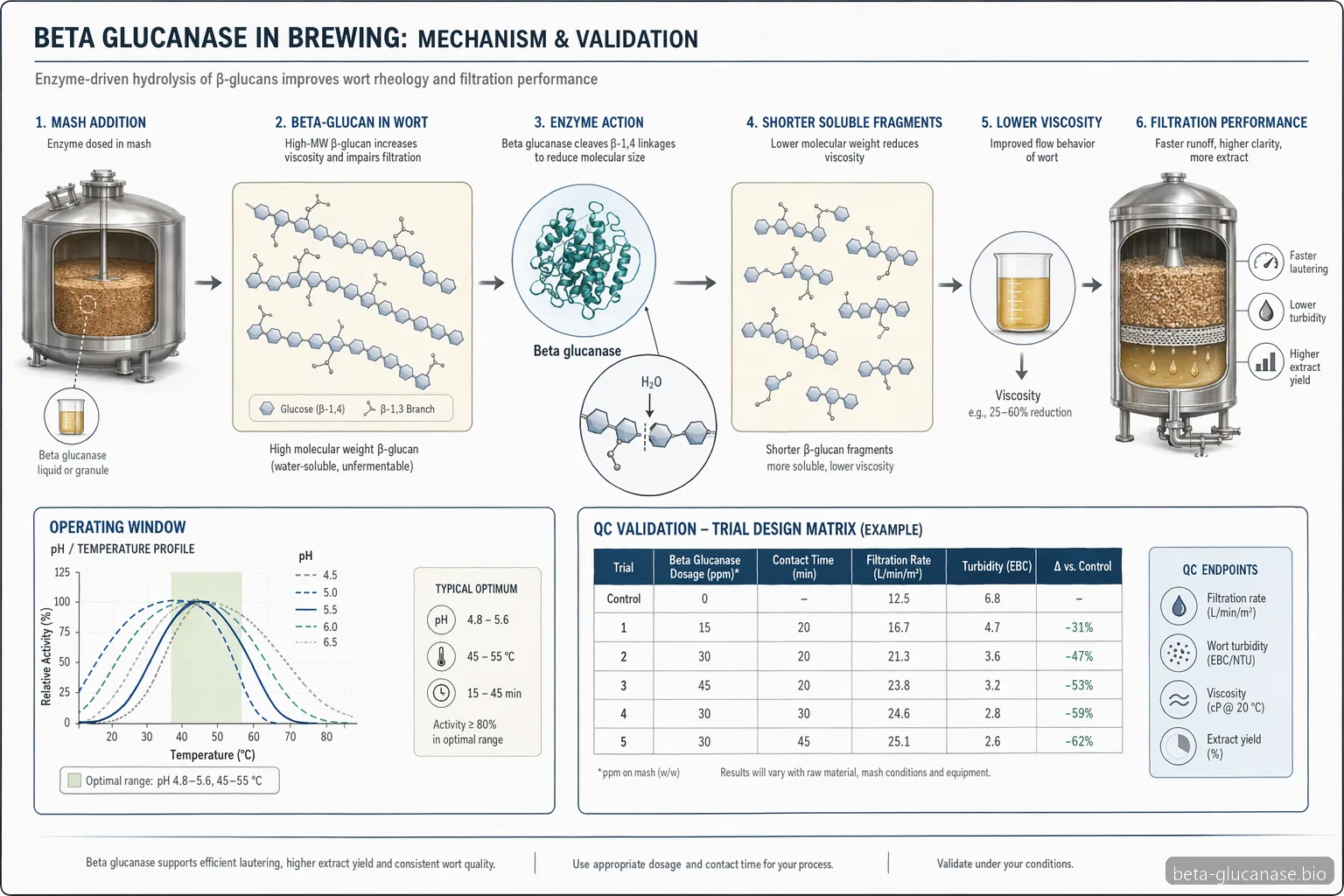
For beta glucanase enzyme brewing applications, the most common addition point is the mash, where the enzyme contacts hydrated grist before lautering. It may also be added in a cereal cooker or pre-mash slurry when using high-adjunct recipes. Practical conditions depend on the enzyme source and formulation, but many brewing beta glucanase products are evaluated around pH 4.5-6.0 and 40-65°C. Some enzymes lose activity rapidly above their thermal tolerance, so addition before high-temperature rests or boiling should be validated carefully. A typical process trial compares untreated control mash against one or more dosage levels while holding grist, liquor ratio, rest time, and temperature constant. The goal is not maximum enzyme addition, but the lowest effective dose that improves flow and quality without unnecessary cost.
Common addition: mash-in or early mash rest • Evaluate pH 4.5-6.0 unless supplier TDS states otherwise • Avoid assuming survival through high-temperature rests
Dosage Bands and Trial Design
Dosage should be set by activity units, substrate load, and supplier recommendation, not by volume alone. As a starting industrial screening range, breweries often test low, medium, and high additions within the supplier’s TDS guidance, commonly expressed per tonne of grist, per hectoliter of mash, or by enzyme activity units. If no plant history exists, request a recommended screening band from the supplier based on malt modification, adjunct percentage, and target process issue. A good pilot design includes one untreated control, at least two dosed conditions, and repeated runs if raw material variability is significant. Track the full cost-in-use: enzyme price, dose, extract impact, filtration time, utilities, labor, yield, and potential reduction in process interruptions. Final approval should be based on repeatable value, not a single favorable brew.
Use supplier activity units wherever possible • Test against an untreated control • Calculate cost-in-use, not only price per kilogram
Quality Control Checks for Brewing Validation
QC should confirm that the beta glucanase enzyme improves the bottleneck it is intended to solve. Useful measurements include wort viscosity, lautering or mash filter cycle time, turbidity, extract recovery, fermentability, and residual beta-glucans where laboratory capability exists. Brewers often monitor whether the treated wort shows reduced slow runoff, less stuck mash risk, and lower differential pressure during filtration. Finished beer checks should include haze tendency, sensory screening, and any brewery-specific stability tests. Because beta-glucans can vary by crop year, maltster, barley variety, and adjunct percentage, one raw material trial may not be enough. The best practice is to validate under normal and challenging grist conditions, then define operating limits in the brewery’s internal process specification.
Measure viscosity and runoff time • Check extract, turbidity, filtration pressure, and haze risk • Validate with representative malt and adjunct lots
Documentation Buyers Should Request
Industrial enzyme procurement should include technical and compliance documentation before plant use. Request a current Certificate of Analysis, Technical Data Sheet, and Safety Data Sheet for the exact beta glucanase enzyme product and formulation. The COA should identify the batch, activity result, specification limits, appearance, and any routine microbiological or impurity checks that the supplier performs. The TDS should state activity definition, recommended pH and temperature range, dosage guidance, storage conditions, shelf life, and handling instructions. The SDS should support workplace risk assessment, PPE selection, spill response, and transport review. Buyers may also request statements on composition, food-processing suitability, allergens where applicable, country of origin, and change-control process, without assuming certifications that have not been verified.
Review COA, TDS, and SDS before approval • Confirm activity method and specification limits • Ask about change notification and batch traceability
Supplier Qualification and Scale-Up
Supplier qualification should combine documentation, sample testing, commercial reliability, and technical support. A qualified beta glucanase supplier should be able to explain the enzyme’s operating window, recommended use point, activity assay, formulation stability, and storage requirements. During scale-up, confirm that dosing equipment can deliver the product accurately and that the enzyme disperses evenly in the mash or slurry. Liquid products may need temperature-controlled storage or agitation guidance, while dry products may require dust control and validated make-down procedures. Commercial evaluation should include lead time, packaging size, minimum order quantity, lot traceability, shelf life, and technical response time. For ongoing control, define incoming inspection, retained sample practice, and requalification triggers when grist composition, malt supplier, or brewing process conditions change.
Confirm storage, handling, and dosing compatibility • Assess lead time, packaging, shelf life, and traceability • Revalidate after raw material or process changes
Technical Buying Checklist
Buyer Questions
Beta glucans are cereal cell-wall polysaccharides found in barley, malt, oats, rye, and some adjunct grains. In brewing, high beta glucans can increase mash and wort viscosity, slow lautering, and add filtration load. Their level depends on crop, malt modification, adjunct percentage, and process conditions. Industrial beta glucanase enzyme is used to hydrolyze these polymers during processing.
Beta glucanase is used to reduce beta-glucan-related viscosity during mash or adjunct processing. The main operational goals are improved wort separation, more stable runoff, reduced stuck mash risk, and lower filtration pressure where beta-glucans are a bottleneck. It should be validated against plant-specific raw materials and process targets rather than treated as a universal additive.
Many brewing trials begin around pH 4.5-6.0 and 40-65°C, but the correct range depends on the specific enzyme formulation and its TDS. Brewers should test under actual mash conditions, including contact time and temperature ramp. If the mash moves quickly to high-temperature rests, confirm whether the enzyme has enough active time before thermal inactivation.
Compare suppliers by documented enzyme activity, performance under brewing conditions, batch consistency, COA detail, TDS clarity, SDS completeness, storage stability, packaging, lead time, and technical support. Request pilot samples and run controlled brews before approval. A lower unit price may not be best if the enzyme requires higher dosage or provides less reliable process improvement.
Cost-in-use combines enzyme price, dosage, batch size, extract recovery, filtration time, throughput, utilities, labor, and reduction in production interruptions. It should be calculated from pilot or plant data, not only supplier price per kilogram. Include the cost of handling and storage, and compare treated brews with untreated controls under similar grist and operating conditions.
Beta-Glucanase for Research & Industry
Need Beta-Glucanase for your lab or production process?
ISO 9001 certified · Food-grade & research-grade · Ships to 80+ countries
Frequently Asked Questions
What are beta glucans in brewing raw materials?
Beta glucans are cereal cell-wall polysaccharides found in barley, malt, oats, rye, and some adjunct grains. In brewing, high beta glucans can increase mash and wort viscosity, slow lautering, and add filtration load. Their level depends on crop, malt modification, adjunct percentage, and process conditions. Industrial beta glucanase enzyme is used to hydrolyze these polymers during processing.
What is beta glucanase used for in a brewery?
Beta glucanase is used to reduce beta-glucan-related viscosity during mash or adjunct processing. The main operational goals are improved wort separation, more stable runoff, reduced stuck mash risk, and lower filtration pressure where beta-glucans are a bottleneck. It should be validated against plant-specific raw materials and process targets rather than treated as a universal additive.
What pH and temperature should be used for beta glucanase enzyme brewing trials?
Many brewing trials begin around pH 4.5-6.0 and 40-65°C, but the correct range depends on the specific enzyme formulation and its TDS. Brewers should test under actual mash conditions, including contact time and temperature ramp. If the mash moves quickly to high-temperature rests, confirm whether the enzyme has enough active time before thermal inactivation.
How should an industrial buyer compare beta glucanase suppliers?
Compare suppliers by documented enzyme activity, performance under brewing conditions, batch consistency, COA detail, TDS clarity, SDS completeness, storage stability, packaging, lead time, and technical support. Request pilot samples and run controlled brews before approval. A lower unit price may not be best if the enzyme requires higher dosage or provides less reliable process improvement.
How is cost-in-use calculated for beta glucanase enzyme?
Cost-in-use combines enzyme price, dosage, batch size, extract recovery, filtration time, throughput, utilities, labor, and reduction in production interruptions. It should be calculated from pilot or plant data, not only supplier price per kilogram. Include the cost of handling and storage, and compare treated brews with untreated controls under similar grist and operating conditions.
Related: Beta-Glucanase for Brewing Wort Viscosity and Lautering
Turn This Guide Into a Supplier Brief Request a technical review, sample plan, and COA/TDS/SDS package for beta glucanase enzyme validation in your brewery. See our application page for Beta-Glucanase for Brewing Wort Viscosity and Lautering at /applications/beta-glucanase-brewing-wort-viscosity/ for specs, MOQ, and a free 50 g sample.
Contact Us to Contribute