Beta Glucanase in Brewing: Industrial Enzyme Supplier Guide
Source beta glucanase for brewing with process ranges, dosage guidance, QC checks, COA/TDS/SDS needs, pilot validation, and cost-in-use tips.
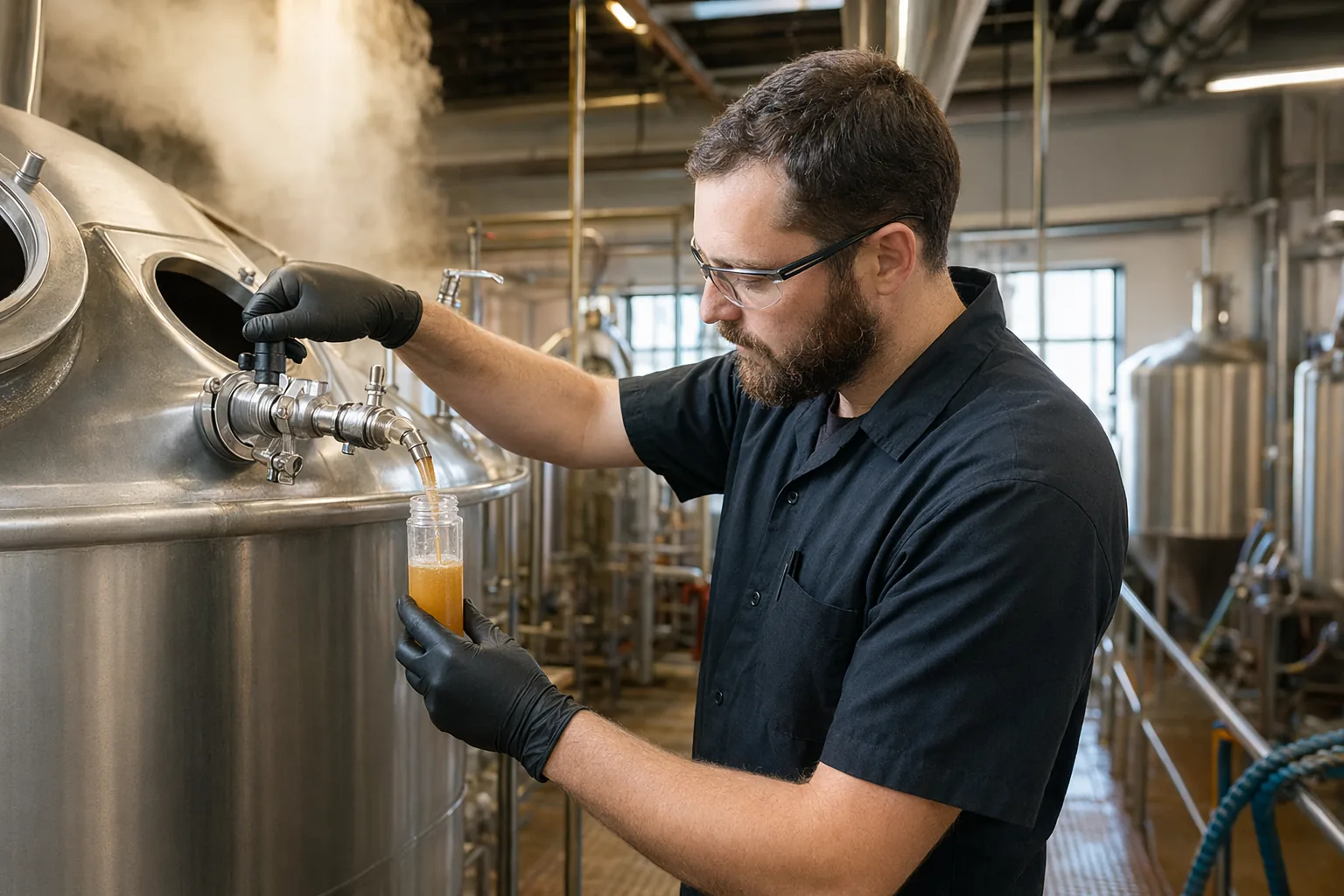
Choose the right beta glucanase enzyme brewing solution to improve mash filtration, wort separation, and process consistency in commercial breweries.
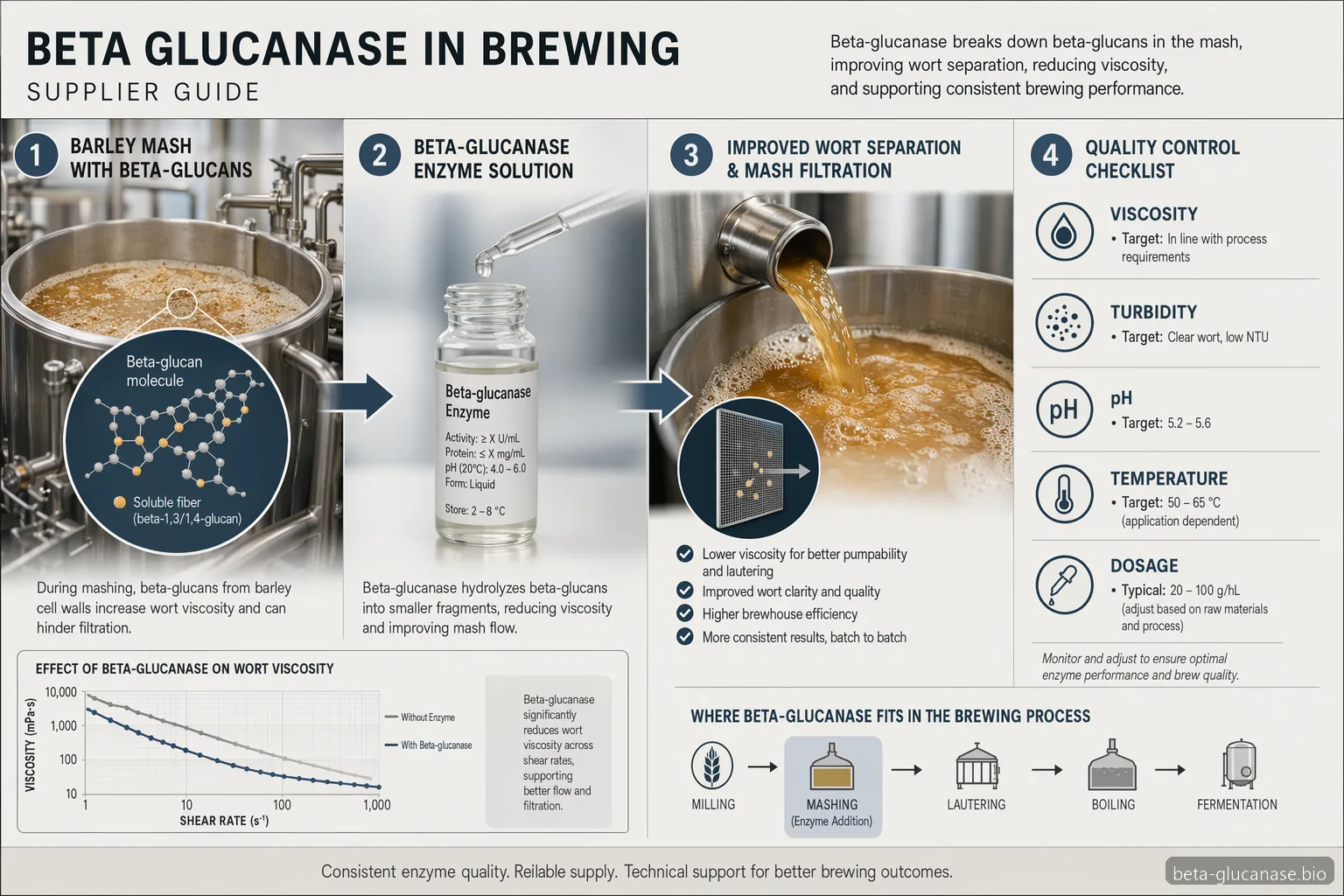
Why Beta Glucans Matter in Brewing
Beta glucans are soluble cell-wall polysaccharides found in malted barley and many adjunct grains. For buyers asking what are beta glucans, the brewing answer is practical: elevated beta-glucans can increase mash and wort viscosity, slow lautering, burden filtration, and contribute to haze or inconsistent downstream processing. Foods with high beta glucans, such as oats, barley, rye, and certain wheat fractions, are also common brewing raw materials or specialty adjuncts. When malt modification is variable or high-adjunct recipes are used, natural malt enzyme activity may not be enough. Beta glucanase in brewing supports the controlled hydrolysis of beta glucans into lower-molecular-weight fragments, improving liquid-solid separation and process flow. For industrial breweries, the key is not simply adding an enzyme, but selecting a beta glucanase product with the right activity profile, process tolerance, documentation, and batch-to-batch reliability.
Common risk points: under-modified malt, high barley adjuncts, oats, rye, and high-gravity brewing. • Typical symptoms: slow runoff, high wort viscosity, filtration pressure rise, or haze risk. • Buyer priority: measurable process improvement under existing brewery conditions.
What Is Beta Glucanase and How It Works
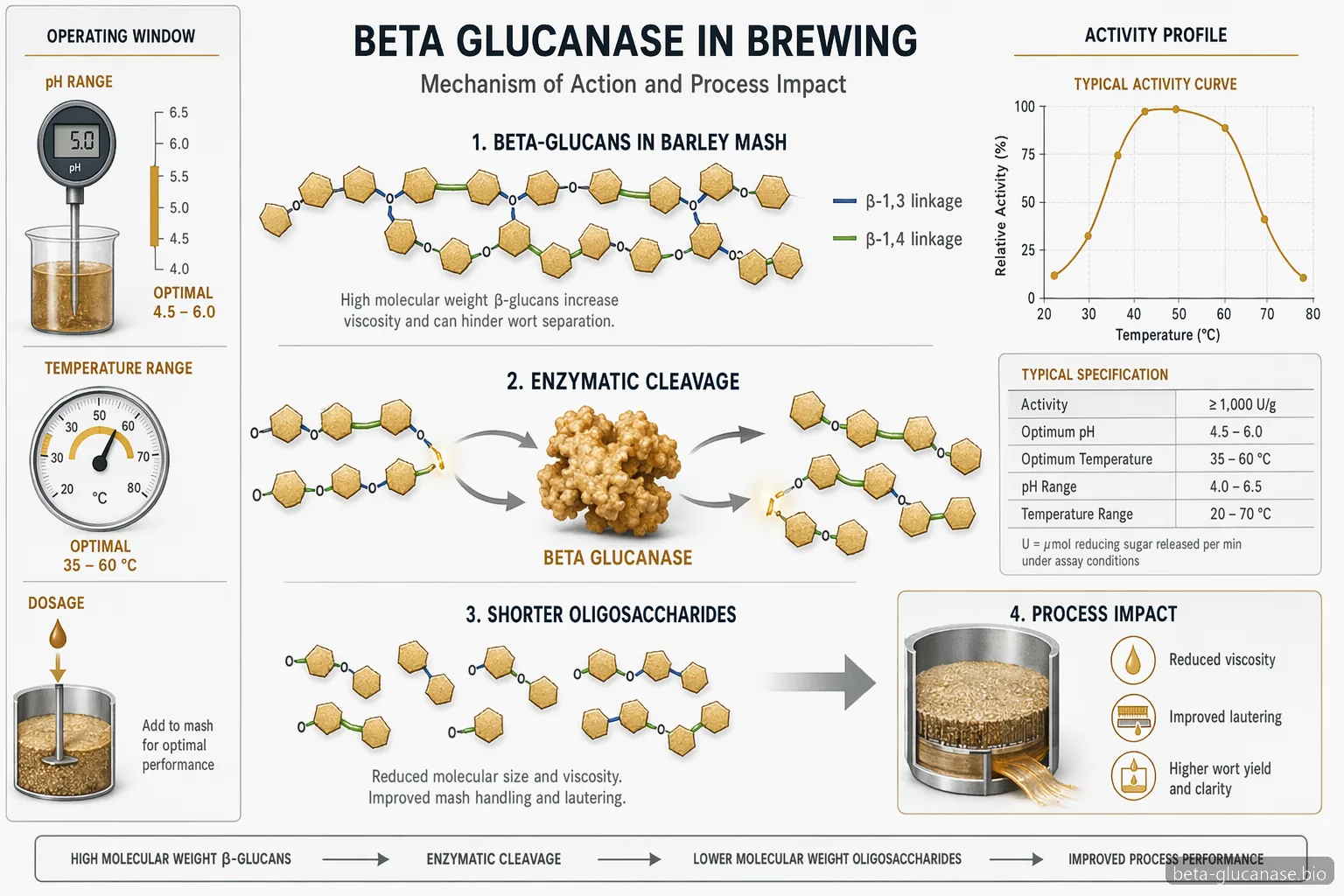
What is beta glucanase? In brewing, beta-glucanase refers to enzymes that break beta-glucans by cleaving glycosidic bonds within the polymer chain. Many brewing formulations include endo-glucanase activity, which attacks internal bonds and rapidly lowers viscosity. Depending on the enzyme source and formulation, products may differ in pH optimum, temperature tolerance, side activities, granulation, liquid stability, and carrier system. A beta glucanase enzyme brewing product should be matched to the mash profile, raw material mix, and desired process outcome. For example, an enzyme added early in mash-in must retain activity long enough at the brewery’s pH and temperature, while an adjunct treatment step may require different thermal stability. Buyers should request the activity definition, analytical method, recommended dose basis, and any known side activities that may affect extract, fermentability, foam, or sensory targets.
Endo-glucanase activity is commonly valued for fast viscosity reduction. • Activity units are supplier-specific unless the assay method is stated. • Side activities should be disclosed in the TDS or technical discussion.
Process Conditions and Dosage Guidance
Commercial beta-glucanase dosage should be confirmed by pilot validation, but preliminary screening often starts in broad dosage bands such as 10 to 100 g per metric ton of grist for concentrated dry products, or 50 to 300 mL per metric ton for liquid products, depending on activity strength. Many beta glucanase products perform in mash pH ranges around 4.5 to 6.0, with practical use temperatures often between 40 and 65°C. Some products may tolerate higher or lower conditions, so the TDS should always govern. Addition points include mash-in, low-temperature rests, cereal cooker discharge, or adjunct slurry treatment. Avoid relying on generic claims; evaluate residual viscosity, runoff time, wort beta-glucan level, turbidity, extract yield, and filtration performance. Heat inactivation is usually achieved during wort boiling, but confirm process carryover expectations with the supplier.
Starting pH screen: approximately 4.5 to 6.0, subject to product TDS. • Starting temperature screen: approximately 40 to 65°C for many mash applications. • Pilot dose range should bracket the supplier’s recommended minimum and maximum.
Quality Control Checks for Brewery Trials
A structured trial prevents overbuying, underdosing, or misattributing results to the enzyme. Before testing beta glucanase in brewing, establish a baseline using the same malt lot, adjunct bill, grist ratio, mash program, and lauter setup where possible. Measure wort viscosity, beta-glucan concentration if available, runoff time, spent grain moisture, extract, turbidity, filterability, and fermentation performance. For packaged beer, monitor haze, sensory neutrality, foam, and microbiological status according to brewery procedures. A good supplier can help design a statistically useful pilot without disrupting production. Document addition method, dilution water quality, pump compatibility, residence time, and actual mash pH and temperature. If the enzyme is intended for recurring use, repeat testing across seasonal malt variation. The goal is a defensible cost-in-use model, not only a successful single brew.
Compare treated and untreated brews under matched conditions. • Track both process KPIs and finished beer quality targets. • Repeat trials when malt crop, adjunct level, or mash profile changes.
Supplier Qualification for Beta-Glucanase
Industrial enzyme procurement should include technical, quality, regulatory, and logistics review. Ask each beta-glucanase supplier for a current COA, TDS, and SDS, plus storage conditions, shelf life, allergen or carrier disclosures where applicable, country of origin, and recommended handling practices. The COA should list relevant batch identifiers and activity or specification results. The TDS should define the activity assay, dosage guidance, application notes, physical form, solubility or dispersibility, and compatibility limits. For larger breweries, supplier qualification may also include sample traceability, change notification expectations, packaging options, lead time, and support for scale-up. Avoid evaluating only price per kilogram or liter. The better metric is cost-in-use: enzyme cost divided by verified improvements in lautering time, extract recovery, filtration throughput, tank utilization, or quality consistency.
Required documents: COA, TDS, SDS, and clear activity method details. • Commercial checks: lead time, packaging, shelf life, and batch consistency. • Economic checks: cost per brew, cost per ton of grist, and process savings.
Technical Buying Checklist
Buyer Questions
The main benefit is controlled reduction of beta glucans that increase mash and wort viscosity. In practical brewery terms, beta glucanase can support faster lautering, improved wort separation, lower filtration stress, and more consistent processing when raw materials contain elevated beta-glucans. Results depend on malt quality, adjunct level, mash profile, enzyme dose, and residence time, so pilot validation is recommended before routine production use.
Beta-glucanase is commonly added at mash-in, during a low-temperature beta-glucan rest, or during adjunct slurry treatment. The best point depends on the enzyme’s pH and temperature tolerance and the brewery’s mash schedule. Many products are screened around pH 4.5 to 6.0 and 40 to 65°C, but the supplier TDS should define the recommended operating window.
Choose a supplier that provides a current COA, TDS, SDS, activity method, dosage guidance, storage conditions, and technical support for pilot trials. Ask how activity is measured, whether side activities are present, and how batch consistency is controlled. Also review lead time, packaging, shelf life, and change notification practices. Final selection should be based on verified cost-in-use, not only price per unit.
Yes, beta glucanase is often considered when recipes include barley adjuncts, oats, rye, wheat fractions, or other materials associated with higher beta glucans. However, the enzyme should be tested against the exact grist, mash ratio, pH, temperature, and hold time used in production. High-adjunct systems may need dose optimization and additional QC checks for extract, viscosity, lautering, filtration, and finished beer quality.
Start with the supplier’s recommended dosage and run a bracketed pilot trial. Depending on product concentration, initial screens may use broad bands such as 10 to 100 g per metric ton of grist for dry products or 50 to 300 mL per metric ton for liquids. Because activity units vary by assay method, compare products using documented activity, process results, and cost-in-use.
Beta-Glucanase for Research & Industry
Need Beta-Glucanase for your lab or production process?
ISO 9001 certified · Food-grade & research-grade · Ships to 80+ countries
Frequently Asked Questions
What is the main benefit of beta glucanase in brewing?
The main benefit is controlled reduction of beta glucans that increase mash and wort viscosity. In practical brewery terms, beta glucanase can support faster lautering, improved wort separation, lower filtration stress, and more consistent processing when raw materials contain elevated beta-glucans. Results depend on malt quality, adjunct level, mash profile, enzyme dose, and residence time, so pilot validation is recommended before routine production use.
When should beta-glucanase be added during the brewing process?
Beta-glucanase is commonly added at mash-in, during a low-temperature beta-glucan rest, or during adjunct slurry treatment. The best point depends on the enzyme’s pH and temperature tolerance and the brewery’s mash schedule. Many products are screened around pH 4.5 to 6.0 and 40 to 65°C, but the supplier TDS should define the recommended operating window.
How do I choose the right beta glucanase enzyme brewing supplier?
Choose a supplier that provides a current COA, TDS, SDS, activity method, dosage guidance, storage conditions, and technical support for pilot trials. Ask how activity is measured, whether side activities are present, and how batch consistency is controlled. Also review lead time, packaging, shelf life, and change notification practices. Final selection should be based on verified cost-in-use, not only price per unit.
Can beta glucanase be used with high-adjunct brewing recipes?
Yes, beta glucanase is often considered when recipes include barley adjuncts, oats, rye, wheat fractions, or other materials associated with higher beta glucans. However, the enzyme should be tested against the exact grist, mash ratio, pH, temperature, and hold time used in production. High-adjunct systems may need dose optimization and additional QC checks for extract, viscosity, lautering, filtration, and finished beer quality.
What dosage of beta glucanase should a brewery start with?
Start with the supplier’s recommended dosage and run a bracketed pilot trial. Depending on product concentration, initial screens may use broad bands such as 10 to 100 g per metric ton of grist for dry products or 50 to 300 mL per metric ton for liquids. Because activity units vary by assay method, compare products using documented activity, process results, and cost-in-use.
Related: Beta-Glucanase for Brewing Wort Viscosity and Lautering
Turn This Guide Into a Supplier Brief Request beta-glucanase specifications, samples, and pilot-trial support for your brewery process. See our application page for Beta-Glucanase for Brewing Wort Viscosity and Lautering at /applications/beta-glucanase-brewing-wort-viscosity/ for specs, MOQ, and a free 50 g sample.
Contact Us to Contribute