Beta Glucanase Production: Specification Checklist for Industrial Buyers
Compare beta glucanase specs for brewing, feed, and biofuel production: activity, pH, temperature, QC, COA/TDS/SDS, pilot validation, and cost-in-use.
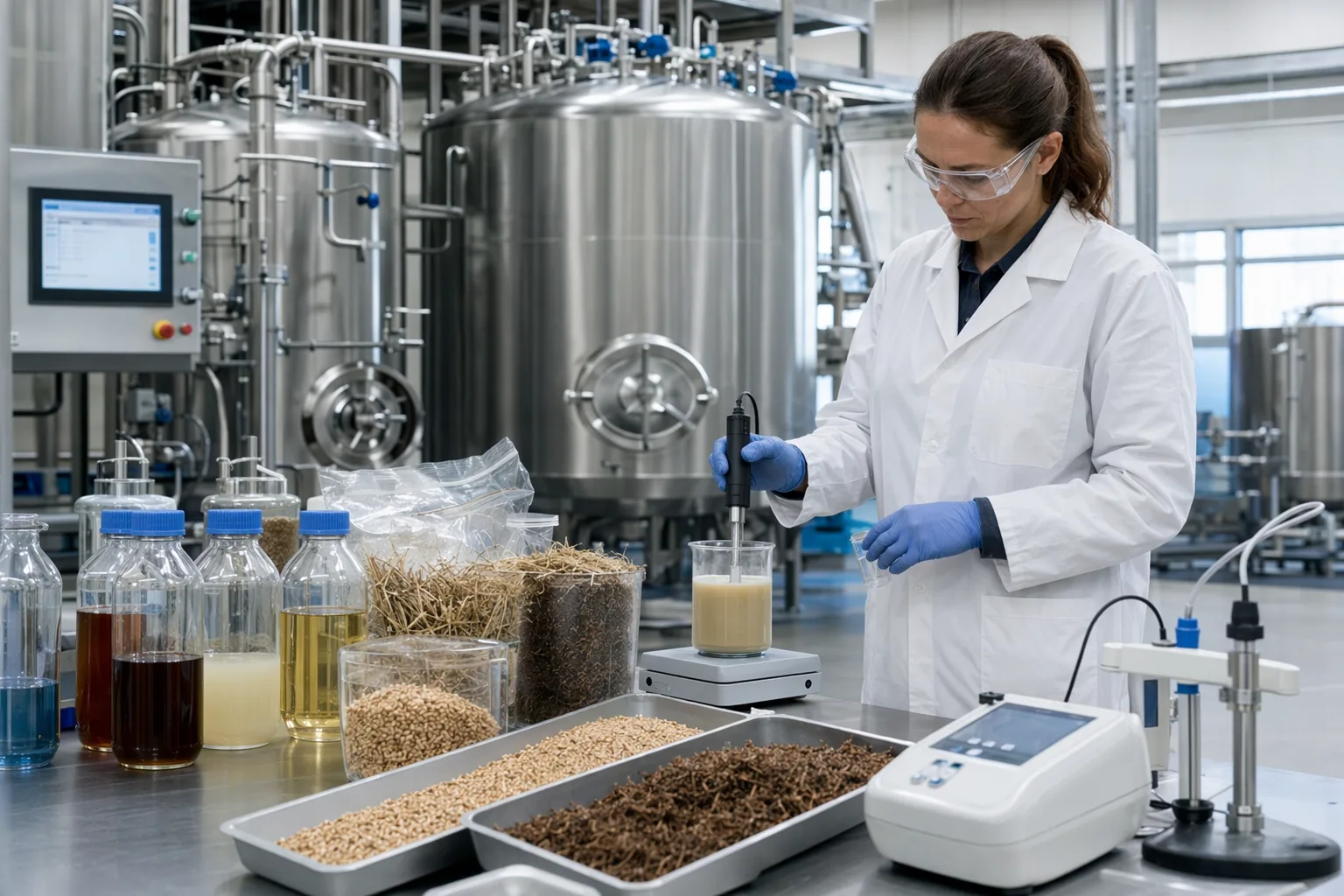
Selecting a beta glucanase enzyme for production is not just an activity-unit comparison. Industrial buyers need to match substrate, process pH, temperature, residence time, regulatory documentation, and total cost-in-use before committing to supply.
What Beta Glucanase Does in Production
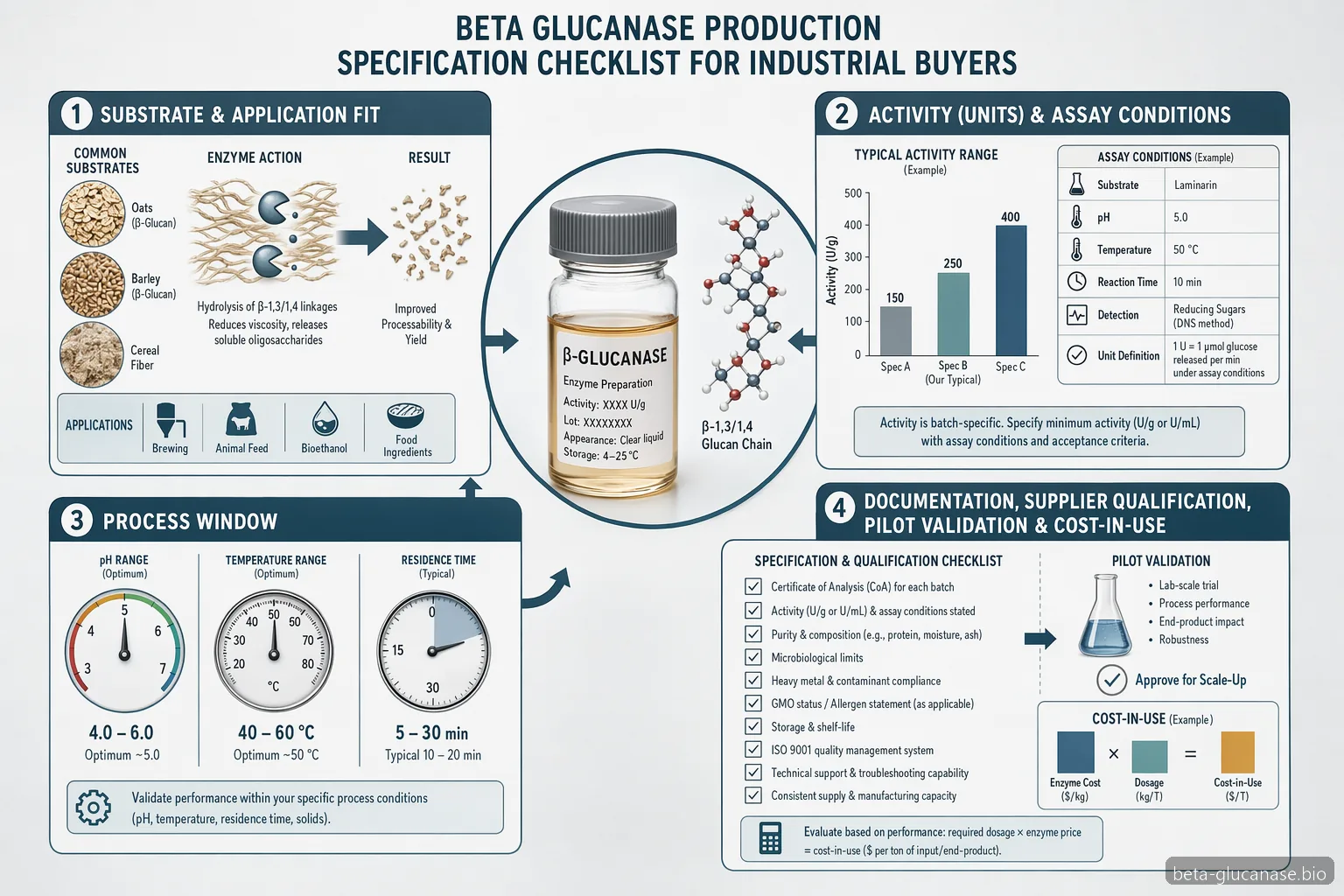
Beta glucanase is an industrial enzyme used to hydrolyze beta glucans, the mixed-linkage polysaccharides found in cereal cell walls, yeast materials, and lignocellulosic feedstocks. For buyers asking what is beta glucanase, the practical answer is a viscosity-control and cell-wall-degrading enzyme that can improve downstream separation, nutrient availability, or fermentable sugar release. In brewing, beta-glucanase helps reduce wort viscosity and supports lautering and filtration. In animal feed, it can reduce the anti-nutritional impact of soluble beta-glucans in barley, oats, rye, and wheat fractions. In biofuel, endo-glucanase activity may be used with broader cellulase or hemicellulase systems to support biomass conversion. The right specification depends on whether the process needs fast viscosity reduction, broad substrate tolerance, thermostability, or compatibility with other enzymes and processing aids.
Primary substrates: barley, oats, rye, wheat bran, yeast cell wall, and biomass fractions. • Common outputs: lower viscosity, improved separation, better substrate accessibility, and higher process consistency. • Key comparison point: real-process performance versus catalog activity.
Start with Substrate and Application Fit
Before comparing suppliers, define the beta-glucans present in your raw material and the performance target in production. Buyers searching what are beta glucans or what is beta glucans often find nutrition-focused content, but industrial procurement needs a processing view. Foods with high beta glucans, such as oats and barley, are relevant because the same cereal chemistry can create high viscosity during brewing or feed processing. A beta glucanase brewing application may need activity at mash pH and moderate temperatures, while pelleted feed may need either thermostable enzyme or post-pellet liquid application. Biofuel applications usually require compatibility with cellulases, xylanases, and pretreatment residues. Ask suppliers to explain whether the product is mainly endo-glucanase, exo-acting activity, or a blended enzyme system, because hydrolysis pattern affects speed and final viscosity.
Brewing target: wort viscosity, lautering time, filterability, and extract recovery. • Feed target: soluble fiber reduction, nutrient release, and pellet-process compatibility. • Biofuel target: biomass accessibility, sugar release, and synergy with enzyme cocktails.
Compare Activity Units and Assay Conditions Carefully
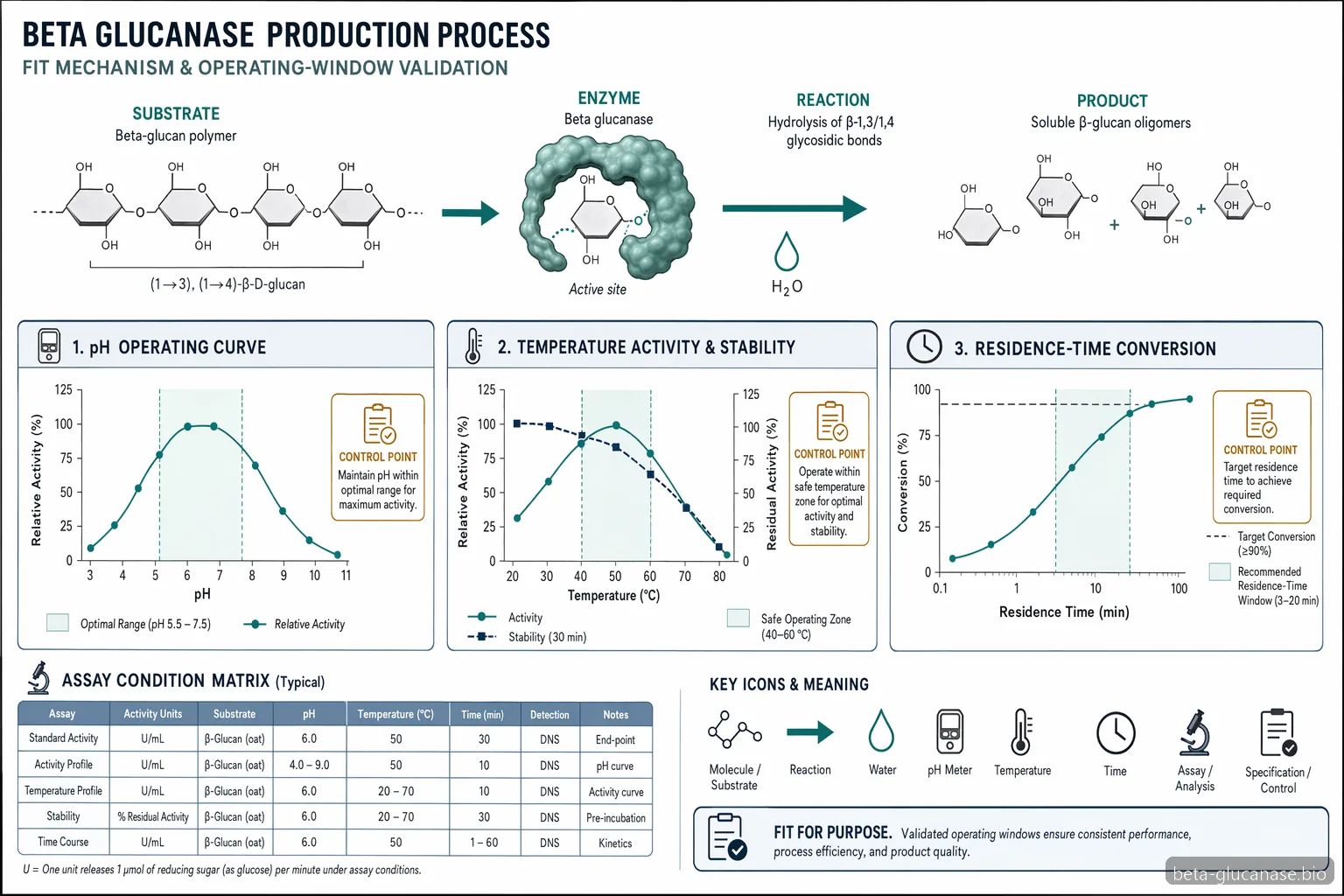
Declared activity is useful only when the assay method, substrate, pH, temperature, and unit definition are understood. Two beta-glucanase products can show similar units per gram but perform differently in production because one assay uses barley beta-glucan while another uses carboxymethyl cellulose or a proprietary substrate. Request the COA for lot-specific activity and the TDS for the official assay description. If the supplier cannot explain the unit definition, comparison by dosage becomes unreliable. Also confirm whether the formulation is liquid, powder, granule, or coated granule, since concentration and handling losses differ. For pilot trials, convert all products to an equal cost-in-use basis, such as enzyme cost per hectoliter of wort, per metric ton of feed, or per dry ton of biomass, rather than purchase price per kilogram.
Check assay substrate and whether it reflects your raw material. • Confirm unit definition, activity range, and acceptable release limits. • Compare dose-response curves, not single-point dosage claims. • Use cost per processed unit as the commercial comparison.
Process Conditions: pH, Temperature, and Residence Time
Most industrial beta glucanase enzyme selection decisions come down to whether the enzyme remains active long enough under actual plant conditions. Brewing trials commonly evaluate performance around pH 4.5-5.8 and 45-65°C, depending on mash schedule and addition point. Feed applications may require activity in the digestive pH window, often around pH 3.5-6.5, or stability through conditioning where temperatures can exceed 75-85°C for short periods. Biofuel hydrolysis often operates near pH 4.5-5.5 and 45-55°C, but pretreatment chemistry and solids loading can shift the requirement. Typical starting dosage bands for screening may range from 10-100 g per metric ton in feed, 1-10 g per hectoliter in brewing liquids, or supplier-defined units per gram of dry biomass. Final dosage must be validated by measured process response.
Define addition point and exposure time before trials. • Measure residual activity or process response after heat exposure. • Check compatibility with proteases, xylanases, amylases, preservatives, and salts. • Avoid extrapolating lab pH results directly to high-solids production.
Documentation and Supplier Qualification
A qualified beta-glucanase supplier should provide more than a price quotation. At minimum, request a current COA, TDS, SDS, recommended storage conditions, shelf-life statement, packaging options, and declaration of carriers or diluents. For regulated production environments, confirm that the supplier can support your internal food, feed, or industrial processing documentation without implying certifications that are not actually held. Review lot traceability, change-control practices, country of origin, production capacity, and lead-time stability. For powders, evaluate dusting potential and worker exposure controls using the SDS. For liquids, check preservative system, viscosity, freeze-thaw sensitivity, and pumpability. Supplier qualification should also include technical support during pilot validation, because troubleshooting pH, temperature, dosage, and interference effects is often what separates a commodity enzyme quote from a production-ready supply relationship.
Required documents: COA, TDS, SDS, storage, shelf life, and packaging specification. • Supplier checks: lot traceability, change notification, capacity, and lead time. • Handling checks: dust, spill response, pumpability, and storage temperature.
Pilot Validation and Cost-in-Use Comparison
The best purchasing decision is based on controlled pilot data that reflects plant conditions. Build a trial matrix with untreated control, current enzyme benchmark, and two or three candidate beta-glucanase products at low, medium, and high dosages. Keep raw material lot, pH, temperature, residence time, agitation, and solids content consistent. Brewing teams should track viscosity, lautering time, turbidity, filtration pressure, extract, and sensory-neutral process impact. Feed teams may track in vitro viscosity, enzyme recovery after pelleting, and animal-performance trial readiness. Biofuel teams should measure sugar release, solids handling, fermentation inhibitors, and yield contribution within the full enzyme cocktail. Calculate cost-in-use from effective dosage, product concentration, losses, rework reduction, throughput gain, and inventory requirements. A product with higher purchase price can be better if it reduces process bottlenecks or performs at lower dosage.
Use side-by-side controls and replicated runs where possible. • Track both technical KPIs and commercial impact. • Confirm scale-up assumptions before annual contracting. • Document final operating window and release specifications.
Technical Buying Checklist
Buyer Questions
Beta glucanase is an enzyme used to break beta glucans into smaller soluble fragments, reducing viscosity and improving substrate accessibility. In industrial production, it is selected for process outcomes such as faster lautering in brewing, improved feed digestibility support, or biomass hydrolysis assistance. Buyers should compare activity profile, substrate specificity, formulation, documentation, and pilot performance rather than relying only on declared enzyme units.
Beta glucans are polysaccharides found in cereal grains, yeast cell walls, and some plant materials. In production, they can increase viscosity, slow filtration, limit nutrient release, or reduce mass transfer. Foods with high beta glucans, such as oats and barley, are useful reference materials, but industrial concerns are processability, separation, yield, and consistency, not consumer health claims or supplement positioning.
For beta glucanase brewing use, compare candidates under the actual mash or addition conditions. Track pH, temperature, residence time, wort viscosity, lautering rate, turbidity, filtration pressure, and extract recovery. Request COA, TDS, and SDS from each supplier, then run dose-response trials. A product with stronger performance at mash pH and temperature may offer lower cost-in-use even if its price per kilogram is higher.
Dosage depends on substrate beta-glucan level, process temperature, pH, contact time, and formulation strength. Screening ranges may start around 1-10 g per hectoliter in brewing liquids, 10-100 g per metric ton in feed, or supplier-defined units per dry biomass mass in biofuel. These are starting points only. Final dosage should be set by pilot data, target KPI improvement, and cost-in-use analysis.
A production-ready supplier should provide a certificate of analysis, technical data sheet, safety data sheet, storage and shelf-life guidance, packaging details, and carrier or diluent information. Depending on the application, buyers may also request lot traceability, change-control procedures, allergen or microbial statements, and regulatory support documents. Avoid assuming certifications or approvals unless the supplier provides current, verifiable documentation.
Beta-Glucanase for Research & Industry
Need Beta-Glucanase for your lab or production process?
ISO 9001 certified · Food-grade & research-grade · Ships to 80+ countries
Frequently Asked Questions
What is beta glucanase in industrial production?
Beta glucanase is an enzyme used to break beta glucans into smaller soluble fragments, reducing viscosity and improving substrate accessibility. In industrial production, it is selected for process outcomes such as faster lautering in brewing, improved feed digestibility support, or biomass hydrolysis assistance. Buyers should compare activity profile, substrate specificity, formulation, documentation, and pilot performance rather than relying only on declared enzyme units.
What are beta glucans and why do they matter to processors?
Beta glucans are polysaccharides found in cereal grains, yeast cell walls, and some plant materials. In production, they can increase viscosity, slow filtration, limit nutrient release, or reduce mass transfer. Foods with high beta glucans, such as oats and barley, are useful reference materials, but industrial concerns are processability, separation, yield, and consistency, not consumer health claims or supplement positioning.
How should beta glucanase brewing products be compared?
For beta glucanase brewing use, compare candidates under the actual mash or addition conditions. Track pH, temperature, residence time, wort viscosity, lautering rate, turbidity, filtration pressure, and extract recovery. Request COA, TDS, and SDS from each supplier, then run dose-response trials. A product with stronger performance at mash pH and temperature may offer lower cost-in-use even if its price per kilogram is higher.
What dosage should be used for beta-glucanase trials?
Dosage depends on substrate beta-glucan level, process temperature, pH, contact time, and formulation strength. Screening ranges may start around 1-10 g per hectoliter in brewing liquids, 10-100 g per metric ton in feed, or supplier-defined units per dry biomass mass in biofuel. These are starting points only. Final dosage should be set by pilot data, target KPI improvement, and cost-in-use analysis.
What documents should a beta-glucanase supplier provide?
A production-ready supplier should provide a certificate of analysis, technical data sheet, safety data sheet, storage and shelf-life guidance, packaging details, and carrier or diluent information. Depending on the application, buyers may also request lot traceability, change-control procedures, allergen or microbial statements, and regulatory support documents. Avoid assuming certifications or approvals unless the supplier provides current, verifiable documentation.
Related: Beta-Glucanase for Brewing Wort Viscosity and Lautering
Turn This Guide Into a Supplier Brief Request a beta glucanase specification review and pilot-trial plan for your brewing, feed, or biofuel process. See our application page for Beta-Glucanase for Brewing Wort Viscosity and Lautering at /applications/beta-glucanase-brewing-wort-viscosity/ for specs, MOQ, and a free 50 g sample.
Contact Us to Contributehello@mail.beta-glucanase.bio